
Ka Malu o Nā Kahu: Stewardship Begins Before the First Shovel Hits the Soil
A Day Hosting Volunteers in the Field with Scott Fisher
For Scott Fisher, HILT’s Director of ʻĀina Stewardship, time in the field at Nuʻu Refuge on Maui involves organizing, educating, and, of course, immersing his hands in the dirt alongside community members. But first…caffeine.
When he hosts volunteer days at Nuʻu, Scott typically wakes up around 6 a.m. at his home in Kula and drinks a quick cup of instant coffee with sugar. Before leaving, he communicates with his staff to confirm he has the required equipment, all of it cleaned and ready for volunteers to use. He often sends a last email to volunteers with driving conditions, including roadwork or animals they should watch for while en route, before loading the equipment into his pickup truck and setting off on the one-hour drive to Nuʻu.
Upon arrival at Nuʻu, Scott and his team provide volunteers, who range from age 2 to octogenarian, with a brief introduction.
“I try to condense that down to about five minutes, but as my wife will tell you, I can oftentimes go on and on,” he says with a laugh. The briefing includes information about potential hazards, such as centipedes, scorpions, and wasps. During this preliminary get-together, Scott also asks if anyone is medically trained and if they are willing to help if another volunteer is injured or becomes ill during the day.
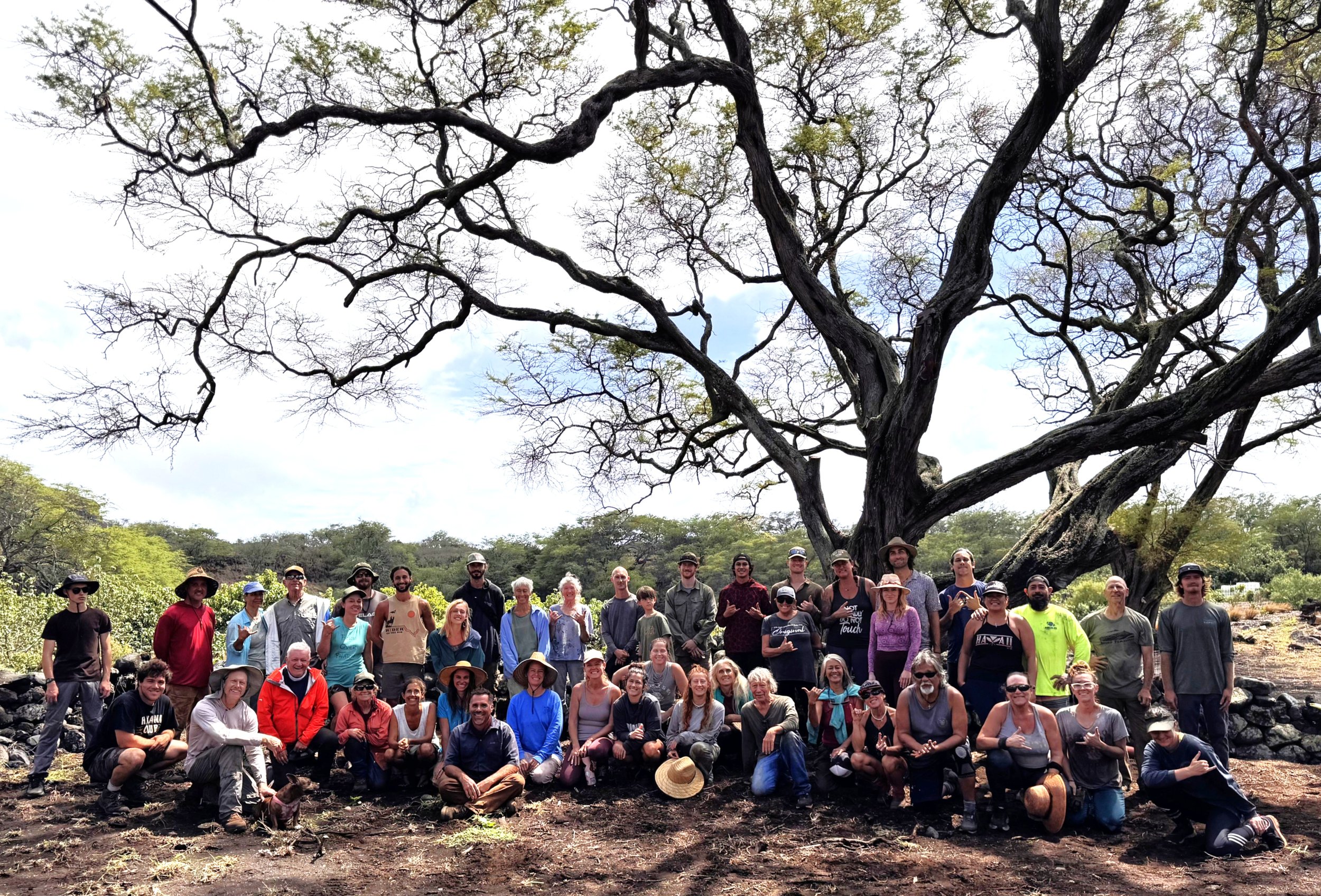
A recent workday group photo.
Once logistics are out of the way, Scott provides the most important part of the welcome—an explanation of the purpose of the work, such as the native forested bio-shield they are creating by planting indigenous, endemic, and Polynesian introduced trees and shrubs to help slow the velocity of a future tsunami event. He also provides a historical overview of the area.
Lastly, before the work begins, Scott leads the group in a pule wehe (opening prayer) he wrote in 2022, meant to the set the tone for a safe and enjoyable day caring for the ʻāina.
“It's really important that we convey that we are not just extracting labor, but our intention is to connect people to land,” Scott says. “There's an `ōlelo no`eau: ‘Huli nā lima i ka lepo, maona ka ʻōpū,’ which means, ‘Turn your hands into the soil and you have a full stomach.’ It’s not just about the physical state of being, but it's also about the spiritual sense that when you connect to land, you're grounding yourself.”
Following the prayer, Scott and his team separate the volunteers into groups of 10 to 12 based on their skills. Staff members oversee different projects, such as weeding, planting, removing invasive plants, or chopping up trees that have already been cut down. Scott floats among them, helping where needed and answering questions.
“When everything is running smoothly, it gets really fun because you see the amount of work that is being accomplished,” Scott says. “It’s really exciting.”
On a recent volunteer day, the group planted 15 to 20 Hala trees, Kukui, and Kou. The group ends their day with lunch, which some volunteers eat by the ocean, while others lower their tailgates for a makeshift dining room. Lastly, Scott takes a group photo, which reinforces camaraderie and the genuine pride that the volunteers have for their accomplishments.
“It’s such a feel-good moment. People are really pumped up, because they can see the plants they planted, the weeds they pulled out, or the area of invasive species they cleared,” he says. “All those things are just so important to the whole process.”
Scott’s Pule Wehe
ʻO Nuʻu kuʻu ʻāina makamae, kuʻu ʻāina aloha mai ka wā ʻōpio mai. He pule aloha kēia, he mele komo hoʻi no nā lehulehu.
Nuʻu, my cherished land, beloved land of my childhood. This is a prayer of love, a prayer to welcome all.
Mai ke awa o Kalokoiki ā i ke kai kūʻono o Huakini, mai Palaoa i Haleakalā ā hiki i ke kai hohonu o ʻAlenuihāhā, ua hoʻopālaha akula kou nani. Ua ola kēia ʻāina i ka ua Peʻe Pōhaku a i ka makani mehana o ʻAiloli.
From the harbor at Kalokoiki to the bay of Huakini, from Palaoa on Halealakalā to the depths of ʻAlenuihāhā, your beauty spreads. This land thrives in the Pe’e Pōhaku rain and is cooled by the ʻAiloli wind.
E hoʻākuleana mai iā mākou i nā _moʻolelo o ke kai lumalumaʻi a me nā moʻolelo o ka moʻowahine ikaika, ʻoia hoʻi ʻo Mākilo, a kona nohona loa i ka loko o Pūpuka. E haʻi hou iā mākou i nā moʻolelo o kāu keiki, ʻo Elia Helekunihi, a me nā kiʻi pōhaku i peʻe ʻia e ia mau makahiki loloa.
Reveal the stories to us, the stories of the destructive wave, the strength of the dragon goddess Mākilo, who lives in the pond of Pūpuka. Speak again of your child, Elia Helekunihi, and the petroglyphs hidden by these long years.
E hoʻohāmama i nā mea i uhi ʻia e ke one kahakai.
Reveal those things covered by the sands of the shoreline
ʻEliʻeli kapu, ʻeliʻeli noa, lele wale ka pule!
It is sacred, it is freed, let the prayer fly!